
by Stacy Bremner, MA, RP
Herbicides have been top of mind for me lately. With over 500 active wildfires burning across Canada as of mid‑August 2026, and smoke reaching places I never remember it reaching in my lifetime, fears are rising that forests are being sprayed as part of forestry practices. Some people are convinced this is happening; others insist it’s misinformation. Either way, there is valid concern with the fires.
🌱 When the “dark” becomes more complex
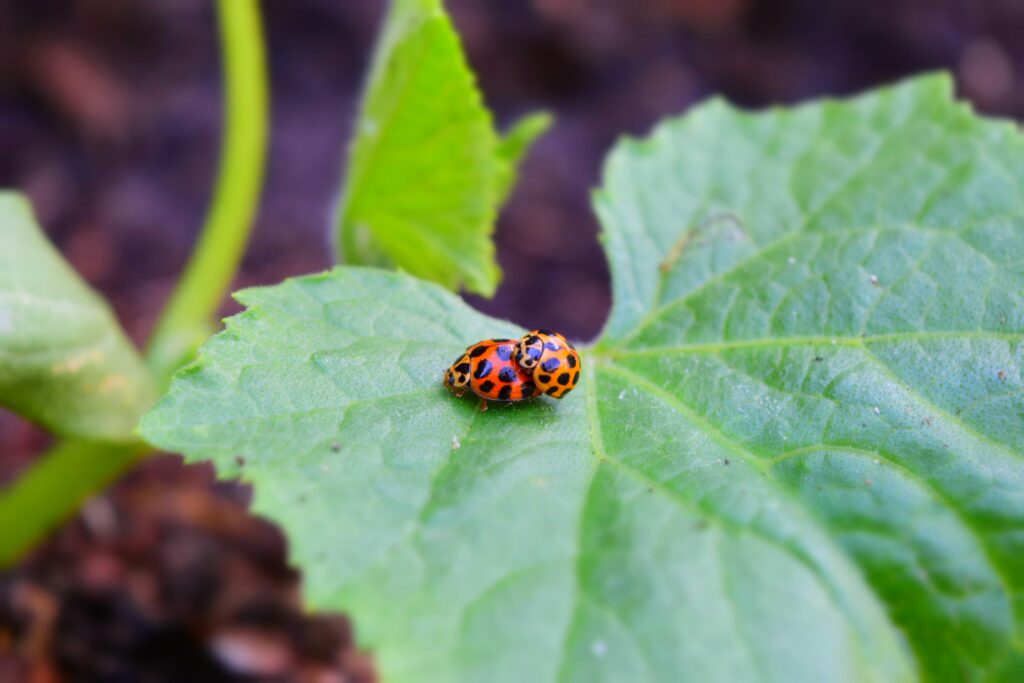
I’ve long felt distressed about the widespread use of pesticides and herbicides. But recently, a friend walked me through her new vegetable garden — rows of corn, tomatoes, beans and greens — and showed me the insects she was suddenly battling. Aphids clustered on leaves, beetles chewing through tender shoots, pests multiplying faster than she could keep up.
Seeing the sheer volume of life she was fighting shifted something in me, in that I no longer saw some of our chemicals as simply “bad”. I started to ponder how they are part of a complicated ecosystem of survival, nourishment, and trade-offs.
The real challenge is finding a balance — using enough intervention to protect crops and prevent destructive infestations, while still safeguarding pollinators and the ecosystems that depend on them. And when I look at this from a global perspective, it becomes even clearer that the goal isn’t to eliminate pesticides entirely, but to use them thoughtfully, minimally, and in ways that preserve the living systems we all rely on.
It reminded me that emotional arguments often simplify what reality complicates.
And this is where I introduce the question for today:
Given what is, what is my role to play?
🌍 Boycotts, beliefs, and the search for purity
When Caring Turns Into Taking a Stand
Many Canadians are boycotting the U.S. right now for political reasons. Twenty years ago, I knew a woman who boycotted airlines because of global warming. Many people today eat plant‑based to protect animals. Some people buy organic as much as possible.
These choices come from caring — deeply. But they also reveal something important:
Even when we take a stand, the world doesn’t necessarily change. But our inner experience does — we may feel more aligned, more principled, more in integrity with ourselves, even if the external outcome remains the same. And this matters, because it speaks directly to the heart of this piece: given what is, the role we choose to play shapes our inner world, even when the outer world doesn’t shift.
Recently I read an article in The Economist (August 8–14, 2026) about Democrats and Republicans agreeing to end animal testing in American labs. At first glance, this sounds like wonderful news. But the article pointed out something important: many medical breakthroughs — including vaccines — require testing on complex biological pathways that cannot be replicated by computer models alone, or with “organs-on-a-chip”. And the most sobering line was this: “If American labs stop testing, the work will only migrate to countries with lower animal‑welfare standards.” China was specifically named.
Therefore, it seems logical that if we truly care about animals everywhere, the goal shouldn’t be to eliminate testing in the places with the highest standards, but to raise the quality of care — more sunlight, more space, more humane conditions. Because the testing will continue (and even increase) somewhere in the world.
Just as humans are never going to stop eating meat, the most honourable path is not purity or avoidance, but ensuring that animals are treated with dignity, health, and wellbeing rather than the disturbing practices shown in documentaries meant to frighten people away from consuming animal products.
When Personal Choices Meet Biological Reality
And this theme shows up in my own life — in a very different but equally revealing way.
I have attempted to eat plant‑based three different times in my life. Each time, I wound up with health problems — muscle weakness, fatigue, inflammation, hormonal shifts — and had to return to including healthy animal sources. I didn’t understand why my body struggled, and I carried guilt because I wanted to “do the right thing.”
But when I received my DNA results, they confirmed what my lived experience had already been telling me: my body does not thrive on plants alone. I need a broader range of nutrients, including animal sources, to stay healthy.
And another tiny bit of advice in those DNA results was this: avoid plastics. A beautiful idea — and literally impossible. Almost every food and household product comes in plastic. Spray bottles, food jars, cleaning supplies, packaging, even the air we breathe contains microplastics now. I can choose wooden cutting boards and glass drinking straws. I can minimize my use. But I cannot escape microplastics completely.
That is the reality we all live in. We can get freaked out, or we can do our best with what we care about.
Most of us are quietly negotiating these same tensions — wanting to live well, wanting to do good things, and learning to accept the limits of what we can control. And maybe part of honourable living is offering ourselves the same compassion we wish the world would show.
And when I zoom out beyond my personal choices, I notice an even deeper longing — one that lives in many of us.
My wish is that humanity would act honourably — not just in small, everyday ways, but in the profound ways that shape the wellbeing of all life. I think most of us quietly long for the same things: an end to war, child abuse, crime, addiction, poverty, starvation, and the exploitation of Mother Earth and all her resources. We wish for a world where animals are treated with care, where children grow up safe and healthy, where communities thrive, and where people stop causing harm that ripples through families and generations. These are the universal heartbreaks we would erase if we could — the heavy realities that sit beneath our personal choices and private hopes.
And yet, I cannot eliminate these things. None of us can. What I can do is live in a way that normalizes honour, compassion, responsibility, and care — in my own small sphere, with the people I touch, in the choices I make, and in the way I show up in the world.
One of the ways I do this is through writing — it’s how I contribute light, steadiness, and nuance to a world that often rushes toward extremes.
This is the role I can play — not perfection, not control, but contribution.
🤖 AI: The new unavoidable companion
A Technology We Can’t Opt Out Of
AI is another example. Most of us use it now, even without realizing it — a simple internet search runs on AI. I’ve never used ChatGPT, but people around me like using it and rely on it daily. And yes, there are controversies with AI in general and ChatGPT, and OpenAI, specifically: water usage, energy strain, ethics.
But AI isn’t going away. Neither are Smartphones or iPads.

Navigating Its Light and Dark
So again: Do I avoid it? Use it mindfully? Stay curious? Stay discerning?
AI and all our technology carries both light and dark — potential harm and potential help, distortion and clarity, overwhelm and support. It’s another reminder that the world rarely offers clean lines.
🔍 The moment of expansion
I love how once I start exploring a topic, something inspired often finds its way to me — as if the universe is nudging me along. Today, on Instagram, Dr. Judy Tsafir shared a teaching that landed with perfect timing: “Given what is, what is my role to play?” It wasn’t just another resource; it was an offering she put into the world, and I happened upon it at the exact moment I was wrestling with these questions myself. Her words didn’t just inspire the title of this blog — they clarified the deeper truth behind it. We may not be able to change the whole world, but we can choose how we show up within it. And that choice, that inner alignment, is often where our real influence lives.
Given what is, what is my role to play?
It reminded me of the Buddhist story Who knows what’s good or bad? Not identical, but related.
Both point to the same truth: Life is complex. Light and dark coexist. And our role is not to control the world, but to respond with clarity. And to continue to see each day as a gift.
🌤️ Choosing your role with gentleness and agency
All of this brings me back to the heart of the matter.
Here’s what I’m noticing:
- I don’t have to react to everything.
- I don’t have to fix everything.
- I don’t have to join every argument.
- I don’t have to collapse into outrage or fear.
I do get to choose what supports my quality of life, what is meaningful for me, and my stance when something feels heavy or dark.
Quality of life isn’t a grand achievement — it’s a series of small, conscious choices.
Sometimes my role is to act, sometimes it’s to observe, sometimes it’s to soften. Sometimes it’s simply to breathe, grieve and carry on.
Light and dark will always exist. Peace comes from remembering that I have agency — not over the world, but over my response to it.
We’re all finding our way through the same complexity. If something here touches your own experience, I’d love to know.
Thank you for reading.